 |
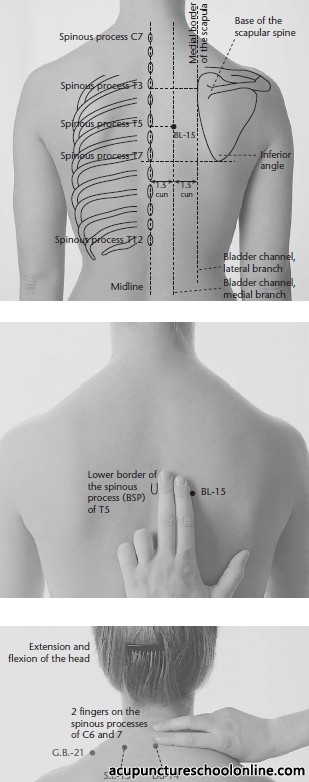
Location Guides: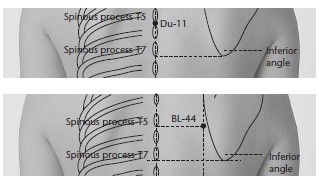 |
Back Shu point of the Heart
Master Tung's Double Phoenixes
Master Tung's Behind the Heart points
Trigger point (Travell & Simons, 1998, Trigger Point Manual; Melzack, Stillwell & Fox, 1977, Trigger Points and Acupuncture Points for Pain: Correlations and Implications, Pain 3, p3-23)
Meeting of Bladder with Bladder Divergent, Gall Bladder Divergent, Liver Divergent, Stomach Divergent, Spleen Divergent, Small Intestine Divergent and Heart Divergent
1.5 cun lateral to the lower border of the spinous process of the fifth thoracic vertebra (T5).
Oblique insertion towards the spine 0.5 - 1 cun, or transverse-oblique insertion 1 - 1.5 cun
Perpendicular needling or oblique needling away from the spine carries a substantial risk of causing a pneumothorax.
"The Taiyang usually has much Blood and little Qi" (Su Wen 素問 ch. 24) implying this channel should normally be bled.
"The foot Taiyang is to be pierced 5 fen deep and remain inserted for seven exhalations" (Ling Shu 靈樞 ch. 12).
"It is needled to a depth of three fen, (the needle) is retained for a duration of seven exhalations, and it is prohibited to moxibustion" (Huangfu Mi 皇甫謐, 3rd Century, Zhenjiu Jiayi Jing 針灸甲乙經).
Tonifies and nourishes the Heart
Regulates Heart Qi
Calms the Shen
Unbinds the chest and resolves Blood stasis
Clears Heart Fire
Superficial Innervation: Posterior cutaneous thoracic nerves from T5
Dermatome Segment: T5
Deeper Structures: Dorsal rami of spinal nerves from T5 if directed inward and accessory nerve (CN XI) if directed into trapezius and dorsal scapular (C5) if directed into rhombus major
Muscle:
Trapezius, rhomboid major or multifidus at deep levels
Pain Referral Pattern:
Trapezius and rhomboid major: Across back and to chest
Multifidus: local to point and to the midline
Indications:
Back and shoulder pain
; Back pain
; Cardiac syndromes
Damage to this point can damage the Heart or cause heart failure or upset the Shen causing social and psychological dysfunction. Can also cause a winding effect (Montaigue, Dim Mak Locations, Taijiworld.com).
Trigrams: Li (Fire) below, Qian (Heaven) above.
Clarity within, strength without — the bright flame rises toward heaven, and all things are illuminated. This is fellowship: the gathering of people around a shared light.
Nuclear Trigrams: Lines 2-3-4 form Xun (Wind). Lines 3-4-5 form Qian (Heaven). Beneath the fellowship, there is gentle penetration (Xun) and creative strength (Qian). The hidden message: the shared light spreads gently, like wind, and is grounded in something universal.
Judgement:
同人于野,亨。
Fellowship in the open country. Opening.
The Heart houses the Shen which is about connection, that should not be limited to family, clan, or faction. Therefore, this point can open the orifices of the Heart and enable reconnection.
利涉大川,利君子貞。
Beneficial to cross the great river. Beneficial for the gentleman's burning.
Danger can be overcome using this point. Moxa is appropriate, if used correctly.
Overall: Fellowship is good, but only when it is open and universal. The moment it becomes exclusive — "us versus them" — it becomes tribalism. An open Heart can overcome many dangers.
Lines:
| Line | Yin/Yang | Image | Literal Translation | Clinical Reading |
|---|---|---|---|---|
| 1 | Yang | 同人于門,無咎 | Fellowship at the gate. No trouble. | The ability to connect has started to be limited to those who come, and not actively reaching out to others. There is no trouble because the Heart has not yet closed off and this state can be easily reversed. |
| 2 | Yin | 同人于宗,吝 | Fellowship only with one's clan. Regret. | The Heart is closing off to outsiders and resorting to tribalism. There is regret because this destroys true compassion which should extend to all. |
| 3 | Yang | 伏戎于莽,升其高陵,三歲不興 | Hiding weapons in the thicket. Ascending the high hill. For three years, no rising. | The Heart is not just closed off, but becoming conspiratorial. Enemies are seen everywhere, but no action is taken. |
| 4 | Yang | 乘其墉,弗克攻,吉 | Mounting the wall, cannot attack. Auspicious. | Xie Qi attempts to attack the Heart and cause severe paranoia but it is well defended by the Pericardium. Use this well and the attack will fail. |
| 5 | Yang | 同人,先號咷而後笑。大師克相遇 | Fellowship. First weeping and wailing, then laughter. The great army conquers and meets. | The great army suggests Zheng Qi from many sources must be mustered to do battle here and save the Heart from distress. Laughter (笑) may not mean that all ends well. Ling Shu 8 says that "Repletion [of the Heart] results in ceaseless laughter (笑不休)," possibly indicating that this is not a positive outcome, but the cyclical weeping and laughter of Dian Kuang (癲狂). |
| 6 | Yang | 同人于郊,無悔 | Fellowship in the outskirts. No trouble. | The battle is lost and the Shen is uprooted. The person may be unable to maintain stable relationships or even a home, and so they wander, trying to rebuild normality on the fringes of society. There may be acknowledgement of what was done wrong, but only the slow work of rebuilding left to do. |
Image:
天與火,同人。君子以類族辨物。
Heaven and fire: Tong Ren. Thus the gentleman distinguishes the classes of things and analyzes their natures.
Heaven is above, fire is below. The fire rises toward heaven, and all things are illuminated. The gentleman distinguishes the classes of things and analyzes their natures. Fellowship does not mean blurring all distinctions. It means understanding differences clearly — and then bringing them together in a higher unity.
Acupuncture Point Connections:
Shared with Xiaochangshu Bl-27.
Inverted into ䷍ (Tongli He-5 or Wangu SI-4).
Opposed by ䷆ (Jingmen GB-25 or Zhongji Ren-3).
Hexagram attributions are my own with an explanation given in the glossary.
Translations are my own, assisted by DSeek and compared to Richard Rutt's interpretion (2002).
As the back shu point of the Heart this point is the main back point for dealing with all disorders of the heart, including spiritual and psychological issues. It is often combined with Jueyinshu Bl-14 for physical heart symptoms.
Ling Shu Ch. 51, On the Back Transport Points, advises that the back Shu points of the Yin organs should be pressed. If this elicits a response, either pain or the relief of a existing pain, then these points should be supplemented or drained with moxa and not pierced. To supplement with moxa the cone is to be left to burn down naturally, to drain it is to be blown on to make it burn more fiercely.
Ling Shu Ch. 52, On the Wei Qi, considers this to be the tip of the hand Shaoyin meridian with the root being at Shenmen He-7.
One of the Aggressive Energy Drain points in five element acupuncture, along with Feishu Bl-13, Jueyinshu Bl-14, Ganshu Bl-18, Pishu Bl-20 and Shenshu Bl-23, indicated where psychological or emotional issues are blocking treatment. They are needled from left to right, top to bottom, with the exception of Xinshu Bl-15 that is needled last, along with controls outside the Bladder channel at the same levels. If aggressive energy is present the points should become redder than the test points and are left until the redness disappears. If not then needles can be removed and treatment continued.
When using the Bladder or Small Intestine Divergent meridians to expel a pathogen a band around the chest at this point, including Shendao Du-11, Shentang Bl-44 and Shanzhong Ren-17, should be treated with Gua Sha before commencing needling (Cecil-Sterman, 2012, Advanced Acupuncture).
In Master Tung's system a line of points corresponding to the inner back Shu points from T2 to T8, known as the double phoenix points (Shuang Feng), can be pricked to release a drop of blood in cases of pain or numbness in the extremities or arteriosclerosis.
They all relate to the Fire element and the Heart and so have the function of quickening the Blood in the Heart and the extremities (McCann, 2014, Pricking the Vessels).
Tung's Behind the Heart (Hou Xin or Bei Xin) points are located under spinous processes from T4 to T9, 1.5 cun laterally to T4 to T7 and 3 cun laterally from T4 to T6. They are indicated for "wool like furuncles", clove sores, weakness and debility of the Heart zang, Stomach diseases, acute heart disease leading to numbness and paralysis, wind-cold entering the interior, severe wind-cold, stroke, externally contracted diseases that manifest with papules. They clear heat from the Heart and Lung and release the exterior so are useful in dermatological disorders (ibid.).
In ayurvedic medicine:
Vrihati marma point
Size: 1/2 angula (cun)
Structure: Blood vessels
Effect of Injury: Premature death (kalantarpranahar marma)
(Harish Johari, 1996, Ayurvedic Massage, Sanatan Society; Anupama Bhattacharya, n.d. Marma Shastra)
In Tibetan medicine:
Moxa point (AMNH, Tibetan Medical Paintings)
Basic information on location, needle depth, TCM actions, indications and combinations is taken from Deadman et al (2001): A Manual of Acupuncture with additional anatomical information researched by reference to Gray's Anatomy (38th Ed., 1995) unless otherwise referenced. Images were found on acupunctureschoolonline.com and can be traced back to Claudia Focks (2008) Atlas of Acupuncture originally. I cannot claim any credit or rights over them. Other sources should be quoted in the text.
For some of the more unusual terms I have created a glossary here
Woodley Bioenergetics
90 Deane Croft Road,
Eascote, Pinner, Greater London. HA5 1SP
Tel/WhatsApp: +44 (0) 7946 174 829
Email: steve@steve-woodley.co.uk