|
Location Guides: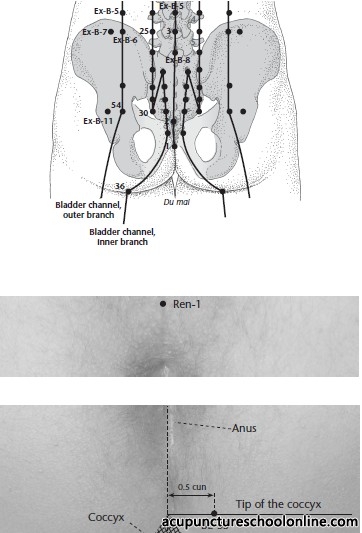 |
Luo-Connecting point of the Du Mai
Doorway to the Earth Point
Meeting of Governing Vessel with Ren Mai, Gall Bladder, Kidney, Bladder Divergent, Kidney Divergent and Uterus Vessel (Bao Mai 胞脉)
On the midline, midway between the tip of the coccyx and the anus.
Perpendicular insertion 0.5 - 1 cun
"It is needled to a depth of three fen" (Huangfu Mi 皇甫謐, 3rd Century, Zhenjiu Jiayi Jing 針灸甲乙經).
Treats haemorrhoids
Benefits the two lower Yin
Activates the channel and alleviates pain
Calms the Shen
Superficial Innervation: Pudendal nerve (L4 - S4)
Dermatome Segment: S4
One of the 36 vital points of Feng Yiyuan 馮一元 listed in the Wu Bei Zhi 武備志 (Treatise on Armament Technology) by Mao Yuanyi 茅元儀 (1621) (McCarthy, 2016, Bubishi: The Classic Manual of Combat).
This is one of the eight non-striking or forbidden points in Northern Praying Mantis Kung Fu. Described as "The bottom of the spine" by Olson (2010, The Complete Guide to Northern Praying Mantis Kung Fu) and "the tailbone" by Wong Honfan (1946; in Ravenswood Academy, 2020, The Eight Forbidden Strikes of Praying Mantis Fist). However Zhongwu Sports considers it to be Du-16 (Zhongwu Sports, 2018, Chinese martial arts "eight hits and eight don't hits"). Both draw from the Chinese "Weilu Fengfu" (tail valley wind palace) and so a more likely answer may mean the entire spine from the "Tail Valley" to the "Wind Palace" referring to this point by name. Damaging the spine anywhere will certainly lead to severe disability or death.
See Montaigue, Dim Mak Locations, Taijiworld.com for explanation of effects.
䷋ Pi 否 Stalemate & ䷗ Fu 復 Returning
Trigrams: Kun (Earth) below, Qian (Heaven) above.
Earth within, Heaven without — the heavy sinks further down and the light rises further up, so they move apart. This is the separation of yin and yang, the moment of standstill.
Nuclear Trigrams: Lines 2-3-4 form Gen (Mountain). Lines 3-4-5 form Xun (Wind). Beneath the standstill, there is stillness (Gen) and gentle penetration (Xun). The hidden message: the standstill is not permanent. There is a mountain that blocks, but also a wind that can eventually wear it down. It can also be noted that Wind under Mountain is the hexagram Gu ䷑ 蠱, which is highly inauspicious, indicating stagnation, decay, or a malicious curse.
Judgement:
否之匪人,不利君子貞,大往小來。
The standstill is not the way of man. Not beneficial for the gentleman's burning. The great departs. The small arrives.
The separation of Heaven and Earth is not the natural order of human society. It is a distortion, a blockage. Moxa is of little help. The Zheng Qi (the great) is departing and Xie Qi (the lesser) is arriving.
Overall: Standstill is the moment when Heaven and Earth separate. The great departs, the small arrives. This is not a time for the gentleman to act. It is a time for withdrawal, for preservation, for waiting for the cycle to turn.
Lines:
| Line | Yin/Yang | Image | Literal Translation | Clinical Reading |
|---|---|---|---|---|
| 1 | Yin | 拔茅茹,以其彙,貞吉亨 | Pulling up Mao grass, in clumps. Burning is auspicious, opening. | Bai Mao is noted by Ge Hong for its ability to repel ghosts. This line implies that it is good to attack malevolent spiritual forces early at this point using moxa to ignite the Yang of Wei Qi and open the Luo of the Du Mai. |
| 2 | Yin | 包承,小人吉,大人否亨 | Embracing and ingratiating. The small man is auspicious. The great man comes to a standstill. Opening. | Xie Qi is accepted by the Luo point which becomes painful, but it is good that the main channel is not affected. However, this is a standstill and the point should be opened to drain it out. |
| 3 | Yin | 包羞 | Embracing shame. | The Luo of the Du Mai is failing and cannot contain the Xie Qi. No advice on how to handle this is given. |
| 4 | Yang | 有命無咎,疇離祉 | There is a decree. No trouble. The companions share the blessing. | As the lines turn to Yang and the Du Mai is being affected, it shows that the time for holding is over and a commanding intervention is required, fortifying multiple adjoining systems to assist, for a successful result. |
| 5 | Yang | 休否,大人吉。其亡其亡,繫于苞桑 | Resting in standstill. The great man is auspicious. "It is perishing, it is perishing!" — tied to a bundle of mulberry shoots. | The Du Mai has failed to contain the Xie Qi early due to resting when it should have been acting, and the Yang is now in danger. Reinforcing the Yang (the great man) can still be effective, if it can be tied to a rebirth, as the mulberry is also an ancient sacred symbol of the cosmic dawn, life, fertility, and deep transformation. It is also a herbal medicine, which could be implied, but it a cooling or yin nourishing herb, which would seem odd when trying to rescue the Sea of Yang, and the reference to shoots indicates more its ancient symbolic function of renewal. |
| 6 | Yang | 傾否,先否後喜 | Overturning the standstill. First standstill, then joy. | The deadlock must be overturned, after which order can be restored. The seeming positive nature of this line is unusual, but recall that Su Wen 5 uses the same character when it says "Joy (喜) harms the Heart," suggesting that damage may be done to the Heart Yang, even if the Du Mai is rescued now. |
Image:
天地不交,否。君子以價德辟難,不可榮以祿。
Heaven and Earth do not unite: Pi. Thus the gentleman restrains his virtue and avoids difficulty. He cannot be honoured with salary.
The image is of Heaven and Earth separated — the creative and the receptive out of harmony. The gentleman restrains his virtue and avoids difficulty. He does not seek reward or recognition. He withdraws, preserves his integrity, and waits.
Acupuncture Point Connections:
This point is unusual in that no other point in the standard sequence shares this hexagram. Its complementary opposite is ䷊ which is attributed to the Luo of the Ren Mai, Jiuwei Ren-15. A connection between these two points is referred to as the Bao Mai, Uterus Vessel, described in Su Wen ch. 47 (see note below).
Among the rising and falling hexagrams that represent the circulation through the Ren and Du Mai, this hexagram is represented by Shanzhong Ren-17.
Hexagram attributions are my own with an explanation given in the glossary.
Translations are my own, assisted by DSeek and compared to Richard Rutt's interpretion (2002).
Ling Shu Ch. 10 describes the diseases relating to the Luo emanating from this point as:
Repletion: The back is stiff
Depletion: The head feels heavy
(Unschuld, 2016).
Ling Shu Ch. 22, On Mania and Madness, advises burning twenty moxa cones at this point if the blood is not excited.
The text says to extract the blood when the disease sets in, store it in a gourd and watch it when the disease strikes again. If the extracted blood is excited and moves then blood is let, if not then this point is cauterised. Something feels like it has been lost in the translation because this was most likely written by an experienced physician and no blood stored in a gourd would ever be excited. Maybe it means to extract blood in the beginning and then observe the blood in the patient's vessels (the Luo and complexion). If it is excited, they become manic and the skin flushes, then to let it out. If it does not and they remain pale and heavy headed then nourish the Luo with moxa at this point.
The Uterus Vessel Bao Mai connects the Heart to the Uterus explaining emotional effects on menstruation. It runs from this point to Jiuwei Ren-15. The Sun Wen, ch. 47 says: "the Uterus Vessel pertains to the Heart and extends to the Uterus... When the period does not come it means the Uterus Vessel is obstructed".
Location of the yang qiao mai in Zhang Boduan's Book of the Eight Vessels on alchemical working, and probably location of the lower barrier (Weilu, Barrier of the Caudal Funnel) at the lowest section of the spine (Wang Mu, 2011, Foundations of Internal Alchemy)
Tensing this point and Ren-1 to raise the anus while performing abdominal breathing is called "Gu Dao", the Way of the Valley, and is an important part of Internal Alchemy and Nourishing Life practices. In "Chinese Pillow Prescriptions (枕中方)," Sun Si-Miao said:
"古人云:日撮谷道一百遍,消除疾病又延年
"Ancient people said: One hundred series of doing Gu Dao everyday, eliminates disease and prolongs life."
It is said to:
1. Flow the Qi into Ren, Du and Chong Mai.
2. Strengthen Dan Tian area.
3. Strengthen pubococcygeus muscle.
4. Facilitate opening of the Microcosmic Orbit.
5. Cure minor ailments.
6. Strengthen internal organs.
7. Gain longevity
The Illustration of Time in the Principles of the Innate Disposition and the Lifespan (Xingming Guizhi, 性命圭旨) describes the movement of prenantal Qi through the microcosmic orbit in terms of the I Ching Hexagrams and the twelve Earthly Branches. It says that:
The prenatal Qi of human beings follows the course of the day:
during the Zi (11 pm - 1 am), the Fu (Turning Back, ䷗) Qi arrives at Caudal Defile (GV 1);
during the Chou (1-3 am), the Lin (Approaching, ䷒) Qi arrives at Kidney Hall [maybe GV 4];
during the Yin (3-5 am), the Tai (Advance, ䷊) Qi arrives at the Mystic Pivot [maybe GV 5 based on name, or GV 7 based on location];
during the Mao (5-7 am), the Dazhuang (Great Strength, ䷡) Qi arrives at the Spinal Handle [possibly GV 10 or GV 11];
during the Chen (7-9 am), the Guai (Eliminating, ䷪) Qi arrives at the Kiln Path (GV 13);
during the Si (9-11 am), the Qian (Initiating, ䷀) Qi arrives at the Jade Pillow (Bl 9 [or GV 17]);
during the Wu (11 am -1 pm), the Gou (Encountering, ䷫) Qi arrives at the Mud Pill (GV 20);
during the Wei (1-3 pm), the Dun (Retreating, ䷠) Qi arrives at Hall of Brilliance (GV 23);
during the Shen (3-5 pm), the Pi (Hindrance, ䷋) Qi arrives at the Centre of the Chest (CV 17);
during the You (5-7 pm), the Guan (Watching, ䷓) Qi arrives at the Central Venter (CV 12);
during the Xu (7-9 pm), the Bo (Falling Away, ䷖) Qi arrives at Spirit Gate (CV 8);
during the Hai (9-11 pm), the Kun (Responding, ䷁) Qi returns to the Sea of Qi (CV 6).
(translated in Liu Lihong, 2019, Classical Chinese Medicine).
Based on some considerations of the hexagram associations given here, the attributions of ䷁ and ䷀ to Huiyin Ren-1 and Baihui Du-20, and a desire to make ䷊ and ䷋ oppose one another at the centre of the body, it would seem that these attributions are where the Qi of a particular hexagram start, and finish at the start of the next, similar to how an hour continues until the next begins. Hence ䷗ governs the region between Changqiang Du-1 and Mingmen Du-4.
Therapeutically, it would make sense that these points are associated with certain aspects of pre-natal Qi and its relation to the associated Zangfu of its Earthly Branch. The hexagram associated with this point represents the return of Yang from within the depth of Yin and is associated with the Earthly Branch of Zi, 11 pm - 1 am, and the Gall Bladder. The Gall Bladder stores and releases Jing making this point particularly associated with Jing.
Based on the Hexagram attributions of the Antique Points, this would correspond to Qimen Liv-14 or Riyue GB-24 which share the Hexagram Fu (Turning Back, ䷗). Its correspondence with the Liver and Gallbladder Mu, its association with the Earthly Branch of the Gallbladder, and its hexagram name of "Turning Back" relates these point's roles in subduing rising Yang and the Gall Bladder's connection to the Curious Organs that are where Jing and Shen combine.
Yuen (2005, 3 Spirits & 7 Souls) describes this point and Huiyin Ren-1 as the Po Men (gate of the soul) where the Po (corporeal soul) exits the body at death through the anus.
This point is also on the 3rd trajectory of the Chong mai connecting the Chong with the Du for Invigorating Yang in cases of Bi Obstruction due to Blood Stagnation (Yuen, 2005, The Extraordinary Vessels).
Also from Yuen's school, this point along with Jiuwei Ren-15, as the Luo points relating the Jing level of emotion, are the activation points for the Po and used in treatments relating to the levels of manifestation of the soul.
Berardinis & Navarra (2017). The succession of Po in the ladder of life. https://www.acupuncturesida.com/The-succession-of-Po-in-the-ladder-of-life.aspx
Avicenna describes cupping at this point in his treatise On Cupping:
"Cupping the anus brings fluids from all over the body, including the head. It is good for the intestines, corruption of menstruation, and lightness of the body." (Aspects of Treatment According to General Diseases, 22nd section in Abu-Asab, Amri & Micozzi, 2013, Avicenna's Medicine)
If gates along the microcosmic orbit are considered in terms of qabalistic sephirot then this point would be equivalent to Malkuth.
In ayurvedic medicine:
Guda marma point
Size: 4 angula (cun)
Structure: Muscle
Effect of Injury: Fatal (sadhyapranahar marma)
(Harish Johari, 1996, Ayurvedic Massage, Sanatan Society; Anupama Bhattacharya, n.d. Marma Shastra)
In the Vedic tradition this point would be the likely equivalent of the Muladhara chakra.
In Ayurvedic medicine:
Lad and Durve (2008) in Marma Points of Ayurveda locate a point at the tip of the coccyx called Trik (although they do not connect it with Du-1 for some reason) and associate it with the doshas: Apana Vayu, Ranjaka Pitta and Kledaka Kapha.
They give the following functions:
- Relieves pain
- Benefits urinary and reproductive systems
- Benefits pelvic floor
- Stimulates Kundalini energy
In Siddha medicine some practitioners consider this a "whole body relief spot" (carvanka atankal) able to stimulate all vital spots at once (Sieler, 2015, Lethal Spots, Vital Secrets, p.87).
Adopting a deep squatting position known as varakacanam or "the pose of the wild boar" can protect the Muladhara chakra located here and in turn protect all vital spots in the body (ibid. p.114).
Basic information on location, needle depth, TCM actions, indications and combinations is taken from Deadman et al (2001): A Manual of Acupuncture with additional anatomical information researched by reference to Gray's Anatomy (38th Ed., 1995) unless otherwise referenced. Images were found on acupunctureschoolonline.com and can be traced back to Claudia Focks (2008) Atlas of Acupuncture originally. I cannot claim any credit or rights over them. Other sources should be quoted in the text.
For some of the more unusual terms I have created a glossary here
Woodley Bioenergetics
90 Deane Croft Road,
Eascote, Pinner, Greater London. HA5 1SP
Tel/WhatsApp: +44 (0) 7946 174 829
Email: steve@steve-woodley.co.uk